Showing posts with label Research. Show all posts

Tuesday, 3 December 2013

Audience Feedback

Most of my audience feedback was positive which helped me gain a sense of confidence. They said that my documentary could of been even better if transitions would have been added as well as work on framing could have been done. Other than I got mostly positive reviews for my blog which helped me a lot. If I was to undertake work like this in the future I would feel much more confident.
 As well as that here is some the things I could work on:

  • Looking at interview styles in expository documentaries
  • How interviews are conducted
  • Framing of Interviews
  • Mise-en-Scene
  • Lighting

Saturday, 23 November 2013

Music for Documentary

In order to look for background music for my documentary, I had to look at various copyright free websites until I found a website which is absolutely copyright free and would let me download music for free as well. This is highly beneficial for a student like me as I can't afford to buy music at very high rates and pay for it every time I was to use it. The website that has made it possible for me to download music legally and free of cost is Free Music Archive ( http://freemusicarchive.org/).

Sunday, 10 November 2013

Editing Softwares/ Equipment Research


Editing Software

The editing software that I will use will be Adobe Premiere Pro CC. Adobe Premiere Pro is a complex editing software which allows editing to be done at a high standard. The software will make the product look to a very high standard and can give effortless results. I have used this software before for AS Coursework and found it difficult to use but having said that learnt a lot of new things. The software has many features which not simply let you edit but add many details to your product making it look as professional as possible. I found Premiere Pro extremely hard to use at times when doing my coursework last year so in order to get more practice I looked at more tutorials compared to last year.


In order to edit for my two ancillary tasks I will need to use Photoshop. I have had some previous experience of using Photoshop but still feel a beginner as it was at a very basic level. However in order to prepare I have been watching tutorials on youtube and asking my peers for help if needed. For know I feel this is the right strategy to tackle this and is working out fine.


Equipment

Sony HD AVCHD is the camcorder I will be using to film. I will be able to film in High definition as this is a HD camera. This will give my film a professional quality. With new camera being introduced in the market the features they have has evolved allowing people like me to film almost professionally with it being cost effective.

The Tripod I will be using is called Hama Star 42 Tripod. The tripod is a more advanced the one I had previously used as it allows me to turn the camera around nearly 360 degrees as well as turn it up and down allowing me to get different angles easily. A Tripod is essential when filming as it helps you keep your camera steady and your footage is eliminated of any shaky camera which is a huge error people fall prey to when filming without realising  and a easy way to lose substantial marks.

Monday, 21 October 2013

Character Profiles


The whole idea of an Documentary is to present factual knowledge and let it's audiences know the 'real' truth behind it's doors. Therefore for me 'constructing' characters and creating profiles for them would be harder than I anticipated. However looking at my target audience I know the type of 'characters' I would need in my documentary. Making a first draft of my script has helped me picture the type of characters I would need and looking at my target audience again.

Character 1:-
Age- 16-17
Student who is still in sixth form or collage, and NRI who watches Bollywood films.

Character 2:-
Age- 20-25

Character 3:-
Age- 40-45
Profession- Expert in Analysing NRI audiences and Bollywood films (Expert)

Character 4:-
Age- 25-30
Profession:- Expert in Looking at NRI's in Bollywood Films


Monday, 14 October 2013

5 Minute Sequences of Documentaries

After deciding on my final idea, I wanted to look into the first 5 minute sequences of documentaries, and pick up upon general traits and what is included according to the codes and conventions and what is not. I looked at both Participatory and  Expository Documentaries, however the type that I will be making is Expository.

Stephan Fry's Out There
  • Start of documentary and voiceover of narrator starts
  • Music starts at exactly 0.22 seconds
  • Light, Chirpy music, almost like classical music
  • Screen splits in to 4 little screens to show different people from different racial backgrounds
  • Few interviews are shown at the start in clips of 2-3 seconds showing what is to come in the documentary
  • 1.48 second title comes up on Screen, music reaches pinnacle
  • Narrator himself participates gets interviewed and filmed making this an participatory documentary
  • Clips of public walking
  • Music starts and stops throughout the first 5 minutes
  • Editing becomes fast paced after 0.28 seconds, music sign posts something serious is about to be discussed, in this case the documentary discuses the rights of homosexuals around the world.
  • Mise-en-Scene, natural settings used with the use of outside public areas, room inside a building, dark to neutral colours are used again highlighting a serious subject is being talked about.
  • Voiceover states laws, facts about homosexuality in England, Ireland, Wales.
  • Films a Civil Partnership being performed

NRI Audiences and Bollywood Films

NRI stands for Non Resident Indians. A generic term for all Indians who have migrated to different countries and settles themselves around the world presumably the Western World. Bollywood films or otherwise known as the Hindi Film Industry is a huge lucrative industry where thousands of films are released every year in the Hindi language. One of the latest trends in the new wave generation of Bollywood films is the recognition of NRI audiences. Protagonists in Hindi films are usually NRI's themselves.

File:DDLJ DVD.jpgDilwale Dhulania Le Jayange (1995) was a major release by Yash Raj Films an Indian film production company started by the famous film director Yash Chopra who went on the direct many critically and commercially successful films in his time. DDLJ became highly successful and one of the first Hindi films to feature NRI protagonists who were born and brought up in London but still shared Indian values. The film having NRI's as main protagonists helped it became a big hit with the audiences of the west who loved Hindi films but didn't see a common factor with them. Critic Anupama Chopra said that ''Perhaps the innocence of Raj and Simran's romance in which they can spend the night together without sex because Raj, the British NRI understands the importance of an Indian woman’s honour. Perhaps it’s the way in which the film artfully reaffirms the patriarchal status quo and works for all constituencies—the NRI and the local viewer. Or perhaps it’s the magic of Shah Rukh Khan and Kajol who created a template for modern love, which was hip and cool but resolutely Indian." She also calls the film a milestone that shaped Hindi cinema through the 1990s.         

File:Love Aaj Kal Movie Poster.jpgBeing perhaps the only film on the 90s to stand out amongst it contemporary's with it's main characters as NRI's however in recent years that has changed. Here are some films in the decade to feature NRI's has the main protagonists. 
Love Aaj Kal (2009) a light hearted comedy that talks about two couples and their respective love stories in two different generations. The modern day love story focuses on the couple Jai and Meera who live in London. The film contrasted a modern day love story with a love story set in a older period in India where love marriages where highly unlikely. The films was a success in India and abroad and the NRI story was liked by many modern couples in India.


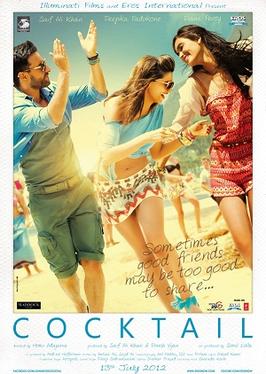
File:Cocktail 2012 poster.jpgCocktail (2012) and Indian romantic comedy film was predominantly shot in London and featured the outgoing character Veronica played by Deepika Padukone. The films was a hit abroad and in India. Commercially and Deepika Padukone was critically lauded for her role as Veronica a young free spirited woman, living a independent life, willing to have no strings attached sex and not be bothered by the 'Indian values'. Rubina A Khan a critic gave the film 4/5 stars, saying that "Cocktail is a contemporary film that reflects life as it happens all around us…. just as crazy, twisted, beautiful, funny, weird and lonely as anyone's life can be. It's about easy choices and hard decisions and how life still goes on, despite it all. It's a cocktail you definitely wanna try!". The unconventional format of the film, the story between three friends who come to terms with some hard decisions in their life made it a hit with the Urban Indian audiences and mostly multiplexes based in big cities such as Mumbai or Delhi compared to the small town viewers who found this too forward for their taste. Aniruddha Guha of DNA India gave the movie 3.5/5 stars, stating that "The best thing about Cocktail is that it is as different as a film can get within a very conventional format. My favourite scene has Gautam talk to Veronica and Meera together about his feelings towards each of them. "Look. You love me. I love her. Let's sort this mess out." A rare moment in Hindi cinema."
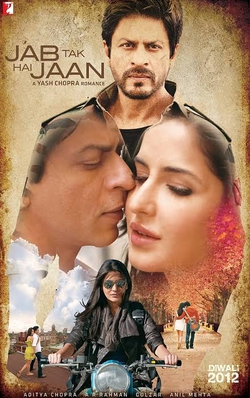
File:Jab Tak Hai Jaan Poster.jpgJab Tak Hai Jaan (2012) another Yash Raj film and the last ever film to be directed by Yash Chopra himself who suddenly passed away while the post-production of the film. The film featured a love story between an Indian migrant Sameer and Meera and NRI born and brought up in rich affluent Indian family in London. Jab Tak Hai Jaan did very well at the Indian and Overseas box office. A love story between an Indian migrant and NRI was praised by Critic's as this was a very unconventional turn. The film grossed £1,619,356 at the UK box office.

Audience Research

I conducted some audience interviews with some NRI's. I found various different reasons as to why an NRI would watch an Hindi film and why one would not. This has helped me bring a focus to my documentary and what I should include in it. The key reason that I found came across in my interviews was the entertainment aspect of Bollywood films. Many Bollywood films don't have the same amount of 'substance' as Hollywood films making them more light hearted or entertaining as they lack the realist aspect. Having said that Bollywood films with aspects of social realism but they tend to be for a niche audience and don't tend to do as well as big budget and full entertainment type Bollywood films. I conducted interviews with Non- resident Indian audiences who watch Bollywood films. I conducted some by filming them and some by writing a transcript of there interview as they didn't want to be filmed.

Transcripts from Interviews conducted


My Audience Research Interviews

Sunday, 29 September 2013

What are Documentaries?

A typical dictionary definition of a documentary is given as something along the lines of using pictures or interviews with people involved in real events to provide a factual report on a particular subject. To even make it more simple a documentary is an informative visual picture put together to inform or entertain an person about any particular subject. A documentary is more of an creative way to document about a particular subject rather than literally reading an document or any other text. 

Bill Nichols (2001) an American critic and theoretician best known for his work on the identification of the 6 distinct modes a documentary can be:- 


The Expository Mode:-  This mode is probably the most common form seen on television. The aim of a expository documentary is usually to inform the audience about a place, an event or any other topic. An expository documentary may develop an argument if wanted to put a point across however that is not always the case. 


Codes and Conventions of Documentaries (Click on image to Enlarge)

Why We Fight Series (1944) is a typical example of a Expository Documentary. A series of propaganda films made by Frank Capra to support WWII.  
The Participatory Mode:- The narrator interacts with the audience, often the central character in the documentary. The documentary puts emphasis on the narrators interaction with the people they meet and their reactions to the interviews  These are called Vox pops , which are mostly used in these types of documentaries. 


Nick Brromfield's Kurt and Courtney (1998) is an example of a Participatory Documentary. 

The Reflexive Mode:- This mode uses specific footage and information that will lead viewers to a specific outcome and therefore essentially make the decision of their opinions for them. They often acknowledge the constructed nature of the documentary, making it obvious to the viewer. These documentaries do not create sense of realism and follow a mockumentary format.  


Louis Theroux's work would be a key example of Reflexive Documentaries here is an example of one of his many works Law and Disorder in Philadelphia (2012). 


The Performative Mode:- They are closely linked to reflexive mode as they both investigate the relationship between the real world and the way in which documentaries represent it. They further challenge to idea of the 'truth' the documentary gives. 
Supersize Me (2004) by Morgan Spurlock is an example of an Performative Documentary. 

The Observational Mode:- This type of documentary looks real life subjects and what goes on in the world around us. It can based around life in an institution such as a hospital, prison clinic or focused around people; their lifestyles. 
 
My Bug Fat Gypsy Wedding (2001) example of an Observational Documentary. 

The Poetic Mode:- An abstract approach to documentaries.They emphasize visual associations, tonal or rhythmic qualities  description and form. They mostly come across as experimental and can bear close resembalance with the avant-garde genre. 

Codes and Conventions of the Poetic Mode:- 

Koyaanisqatsi (1982)  in other words known as Life out of Balance is an documentary film by Godfrey Reggio. The Documentary explores the unseen world using images, videos and music effectively together.